
Natasha Stoianovska: Painting Through the Chaos
When Natasha Stoianovska fled the war in Ukraine in 2022 with nothing but a backpack, she couldn’t have imagined that Wolverhampton would become the place where her artistic journey would truly begin. Arriving in the West Midlands as a refugee, she found herself in a new country, in a new reality, with an urgent need to process grief, uncertainty and hope. What began as a way to ground herself during those disorienting first weeks has since blossomed into a bold and emotionally resonant visual practice.
Natasha is a painter, poet, arts facilitator and storyteller whose work explores themes of trauma, displacement, and resilience. Her expressive canvases, marked by surreal characters, distorted forms, and vivid colour palettes, offer a raw, poetic account of life in flux. For Natasha, art is more than expression; it’s a universal language that connects inner worlds across borders. Since arriving in Wolverhampton, she has become a visible and vital part of the city’s creative community. A three-month residency at Wolverhampton Art Gallery led to an exhibition, while her contributions to More Art Inc., the Birmingham Open Exhibition, and the Multistory Assembly project have helped carve space for her voice in the UK art scene. Alongside this, she works as an arts facilitator supporting other Ukrainian refugees, helping others find the freedom and healing she discovered through paint.
As Natasha looks to the future, with plans for her first solo exhibition, new community workshops, and a group show that champions fellow displaced artists, she continues to push the boundaries of what it means to rebuild a life through creativity. Her story is a testament to the human spirit and the transformative power of art.
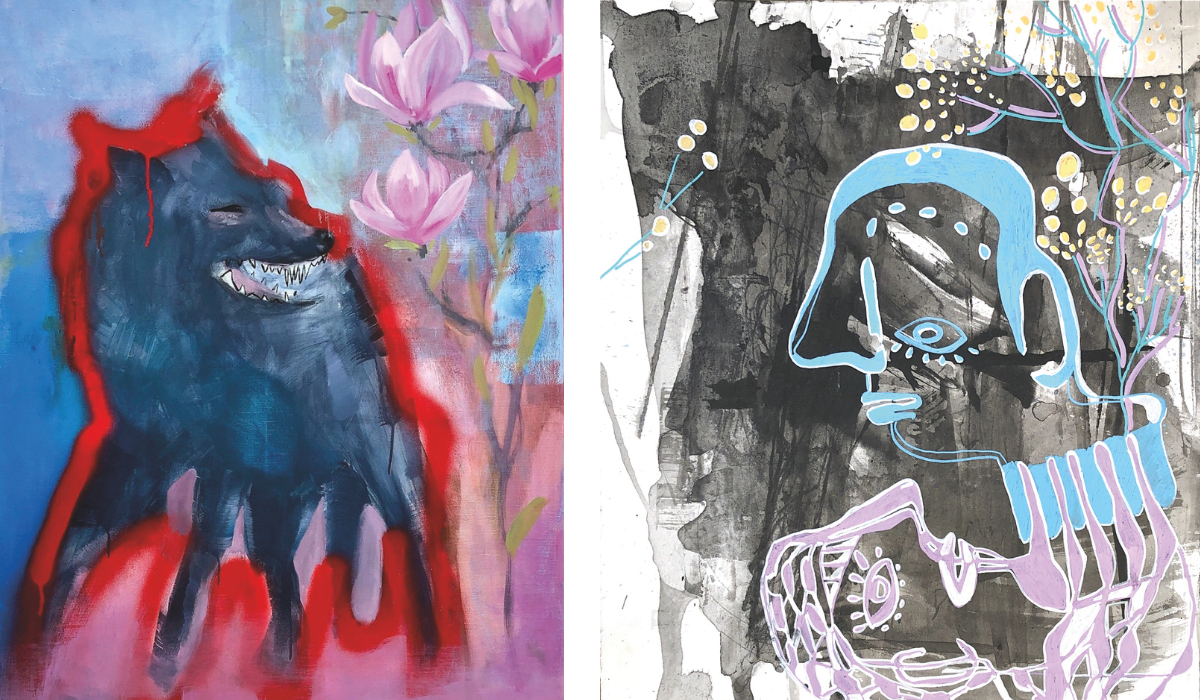
Can you tell us about your experience moving from Ukraine to Wolverhampton? How has your new environment influenced your artistic practice?
Whether a full-scale war in Ukraine would start was speculated about, but no one wanted to believe it could actually happen. How do you even wrap your head around the idea that one day, you might wake up to the sound of shelling? Yet, that’s exactly how my involuntary migration began. I found myself in Wolverhampton with just a backpack, some socks, lingerie, a jumper, my laptop, and documents, not fully realising that my present was already becoming the past. I had to find new meaning in this newly created reality, but my mind resisted the idea of a new present where the future wasn’t promised. In all this dismay, I felt a strong need to ground myself and embrace the moment. That’s how I started doing art. Little did I know that it would shape my future in ways I couldn’t even imagine.
Your art explores themes of trauma, displacement and resilience. How did your journey shape the way you approach these themes in your work?
I’ve always been creative. Before I started painting, I wrote poetry and did film photography. Creativity never left me, it just kept changing form. My painting journey began with an exploration of shapes and colours. I worked intuitively, picking colours that spoke to me the most. Trying to analyse the chaos I created, messy patterns, intense contrasts and whimsical characters, helped me make sense of my feelings in the present. It gave me a way to process and understand emotions that I couldn’t put into words.
Since arriving in Wolverhampton, you’ve participated in local art projects and exhibitions. How has the local art community supported your integration and artistic evolution?
I can’t emphasise enough how important it was for me to get involved in art projects. The Wolverhampton Art Gallery project, especially through More Art Inc., had a massive influence on me. Starting from scratch in a new country, battling self-doubt, and dealing with the subconscious desire to fit in affected me deeply and stunted my growth for a while. But the desire to live and create persevered. That’s what pushed me to apply for these projects and challenge myself to open up. It helped me claim my space, feel seen, and understand that my feelings and experiences matter. Being part of a community where others could relate, even if their journeys were different, was incredibly healing.
You’ve worked as an arts facilitator for Ukrainian refugees. How do you feel art can help others who have experienced trauma and displacement?
It’s like this: when you have so much love that it overflows, you need to share it with others who are just as thirsty for it as I was when I arrived. I can’t stress enough how much art can change your life if you open your heart to it, dedicate your time, and stay curious. Art is a journey of self-exploration. It helps you reconnect with yourself, process your past, and imagine your future. Refugees, in particular, have so much bravery within them, and art gives them a chance to rediscover their identities and find strength in their stories.
Your recent plans included curating a group exhibition and launching your first solo show. What do you hope to achieve with these projects, both personally and for the wider community?
Curating an exhibition for others, especially Ukrainian refugees, is about creating a platform for people who’ve been deprived of the chance to express themselves. Through workshops, I want to help participants explore their feelings and their art, just as art helped me when I first started. As for my exhibition, it’s a love letter to myself. It’s about self-love, self- discovery, and appreciating the journey I’ve been on. It’s also a way of showing gratitude to the people I’ve met along the way and celebrating the joy of being seen and heard. I think seeing all my most important works together in one place will give me a new perspective on my path; it’ll make it all feel like it has come full circle.
You received an offer from the Glasgow School of Art but were unable to enrol due to financial constraints. How has this setback influenced your drive and ambitions as an artist?
The war taught me to always have a plan B for my plan B. When I didn’t get a project coordinator position I applied for, the Glasgow School of Art became my backup plan. And when that didn’t work out, I had to come up with another plan. Now I’m looking for a private studio to deepen my practice, hosting workshops for Ukrainian refugees, and planning group and solo exhibitions. Setbacks don’t stop me. If one door closes, it just means there’s another route I haven’t explored yet. These detours often bring opportunities I couldn’t have predicted and push me to grow in ways I never expected.
Art became your universal language when words could no longer express the complexities of your emotions. Can you talk about a specific piece that best encapsulates this?
A specific piece that best encapsulates this for me is "A Horse with No Name.". The headless horse and the rider without eyes symbolise my own sense of being lost and uncertain, yet still determined to move forward. At that time, I had no clear sense of where I was going or what the future would hold, but I felt an internal drive to keep going despite the unknown. The horse, missing its head, represents the feeling of not having a clear direction, while the rider, who cannot see, reflects that feeling of being in the dark about what’s next. Still, the use of soft pastel colours brings a sense of hope and whimsy, showing that even in the face of confusion, there’s beauty and positivity in continuing the journey. The painting speaks to the universal experience of moving forward when you don’t have all the answers and not knowing exactly where you’re headed, but still holding onto hope and determination. It's a sentiment I couldn’t always put into words, but felt deeply in that moment.
What message or feeling do you hope people take away when they view your work?
I don’t create with the intention of delivering a specific message to others; I just express myself. It’s like singing; whoever listens can interpret it in their own way. What makes me happy, though, is when someone looks at my work and connects with it. If they see its depth and feel something, whether it’s their own pain, joy, or hope, it’s a success to me. It reminds me that we’re all energetically connected. If my emotions on the canvas help someone understand their own, that’s the best outcome I could hope for.